When one hears about Mykonos, his mind automatically travels to wild summer parties, cosmopolitan beaches, and famous clubs. However, there is another Mykonos, hidden beneath the veil of springtime, revealed only to those who visit during Holy Week.
Easter on the “Island of the Winds” is not just a religious celebration. It is a mystical ritual that connects yesterday with today, contemplation with Cycladic hospitality, and authentic flavors with the unparalleled beauty of the Aegean Sea.
The mysticism of Holy Week
1. The whitening
The first thing visitors notice is the dazzling cleanliness. The custom of “whitening” is deeply rooted in the local culture.
The women of the island, with great enthusiasm, whitewash the walls of their houses with lime, as well as the joints between the slabs of the alleys of Chora and Ano Mera. This white “net” that forms on the ground gives the island a freshness that resembles embroidery, setting the stage for the Great Feast.
2. Lazarines
Lazarines are young girls and unmarried women who, on Lazarus Saturday, go around the neighborhoods of Chora and Ano Mera singing carols. They often wear local costumes or are simply adorned with spring flowers. They carry woven baskets, which are elaborately decorated with daisies, poppies, lilies, and other wildflowers from the Mykonian countryside. Housewives traditionally treat them to fresh eggs (which will be dyed on Holy Thursday), money, or Lenten sweets.
3. The solemnity of Holy Friday
Holy Friday, one of the most special and solemn moments of Holy Week on the island, is inextricably linked to the Descent from the Cross at Agios Loukas. The church is located in the central cemetery of Mykonos. As in many parts of Greece, the people of Mykonos visit the graves of their relatives on that day. They clean them, light candles, and leave flowers, waiting for the Descent from the Cross. This ritual is a bridge between the divine drama and each person’s personal loss, giving a sense of comfort and hope for the Resurrection. In the evening, all the Epitaphs from the churches of the village gather at Gialos (the old port). There, a communal prayer is held in a solemn atmosphere by the sea. The atmosphere with the lanterns and the waves is unique. In some villages, such as Ano Mera, a replica of Judas is prepared on Holy Friday to be burned.
4. Holy Saturday and the Resurrection
On the morning of Holy Saturday, the First Resurrection service is held at the Cathedral (Zoodochos Pigi) in Alekandra, as well as in the other parishes. It is a moment full of energy, as the priest scatters laurel leaves (the “vagia”) throughout the church and the faithful bang loudly on the pews, symbolizing the noise of life’s victory over death and the defeat of Hades.
On the night of Resurrection, although most churches are filled to capacity, two places stand out for the experience they offer:
- Agios Nikolaos of Kadenas (Gialos): Perhaps the most picturesque Resurrection. The image of hundreds of candles reflecting in the water of the old harbor is magical.
- Paleokastro Monastery (Ano Mera): For a more traditional and “austere” experience, the women’s monastery in Ano Mera offers a devotional atmosphere away from the lights of Chora.
If you choose to stay in Chora, the Resurrection is accompanied by dozens of fireworks that light up the sky above the Windmills.
5. Easter Sunday and Easter Monday
On Sunday afternoon, in the square of Chora or in Ano Mera, they burn the effigy of Judas, which is filled with gunpowder. After the Vesper service of Love, they set it on fire, creating a spectacular sight that symbolizes the punishment of betrayal.
Easter Monday (or “Bright Monday”) is a day of outdoor activities and excursions for the locals. Many families celebrate in their private chapels (of which there are hundreds on the island). After the service, large tables are set up in the church courtyard. On the other hand, in the square of Ano Mera, a large feast is held with traditional music (tsambounes and toumpakias) and food is offered to everyone. Finally, weather permitting, the people of Mykonos head out to the countryside for what is known as “Easter in the country,” taking food and music with them to the seaside or to the fields in bloom.
The Easter flavors of Mykonos
Mykonian cuisine at Easter is based on exceptional local dairy products and meats:
- Mykonian Cheese Pie: The absolute star. It is a pie made with tirovolia (local cheese), which owes its distinctive fresh taste to onion and dill.
- Lazarakia: Small bread rolls shaped like a person in a shroud, containing raisins, sugar, and spices..
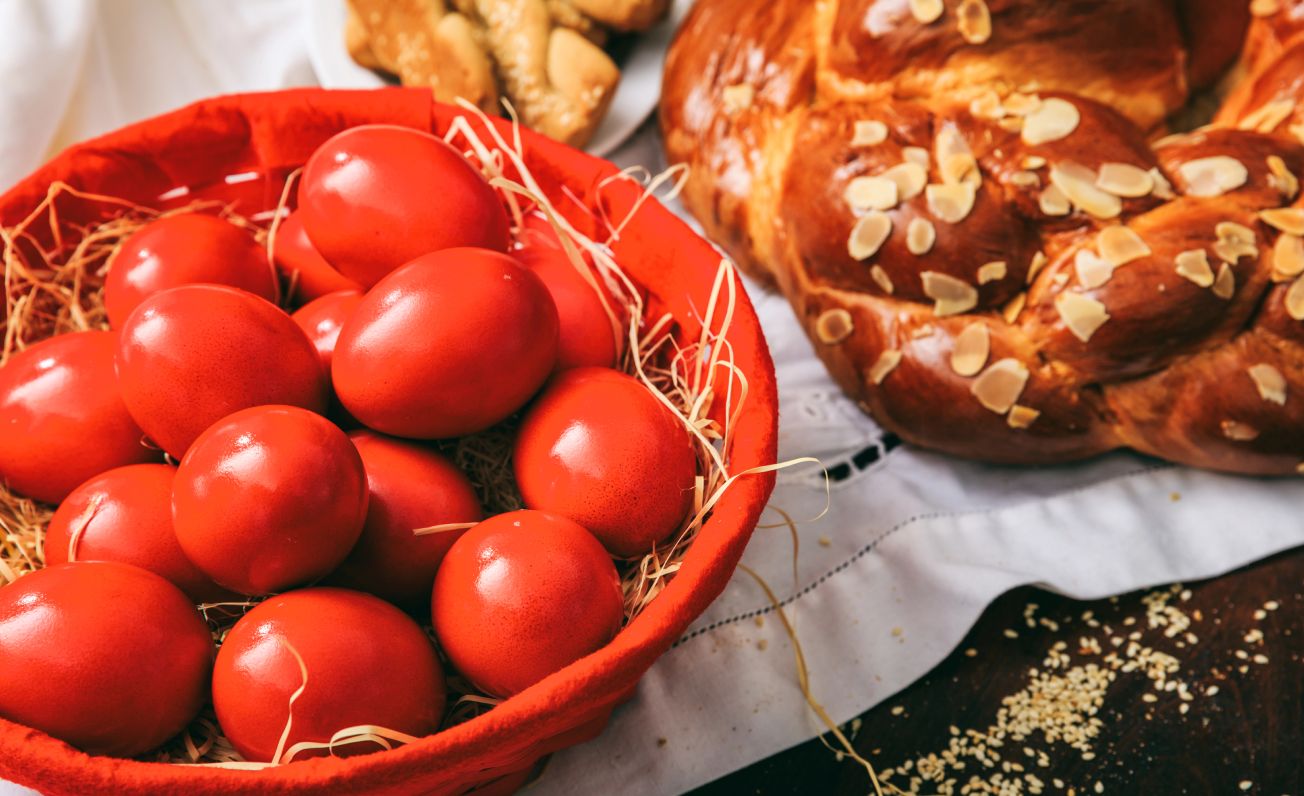
- Easter breads: Impressive sweet breads in various shapes, decorated with red eggs.
- Louza: The traditional Cycladic “pastourma” made from pork, flavored with thyme and spices, which is a staple on every festive table.
- Kopanisti of Mykonos: The island’s famous spicy cheese that accompanies appetizers.
- Magiritsa: The classic soup of Holy Saturday, which in Mykonos is often made with special care using local herbs.
- Lamb or goat: On Easter Sunday, the meat is either roasted on a spit or baked in a traditional wood-fired oven with potatoes and rosemary.
- Protofournia: The first bread to come out of the oven after fasting, usually very fluffy and fragrant.
- Onion pie: Made with Mykonian cheese and dill.
- Melitopita: The traditional Easter dessert. It’s a pie with cheese filling, honey, and cinnamon (reminiscent of a tart but with a unique island flavor).
Spring dresses up in its finest in the blossoming courtyards, and Easter becomes a feast for the senses that is hard to forget. If you are looking for an Easter where tradition has the taste of the sea and the color of Cycladic white, then the road leads to the heart of the Cyclades. Make your reservation at Corfos Pearl Studios in advance, enjoy the authentic hospitality of Mykonos, and live like a local, discovering the unique culture of the island.